If you have Hulu, you might want to check out the TV show, titled "Miss America", which accurately portrays the sweetheart of the silent majority. This tells the story of the movement to ratify the ERA during the second wave of feminism and the backlash led by Phyllis Schlafly. With Schlafly at the lead, the group argued that the ERA would rescind what they deemed to be freedoms and protections for women under the current law and questioned why they should have equality when they were in a "superior" position. Early in the show, Mrs. America illustrates how STOP ERA began to gain traction with the group swaying politicians with bread and pies. in Episode 2, we see Schlafly and her legion of anti-ERA women flock to the lobby of the Illinois General Assembly to hand out homemade bread and jam with the slogan of “Preserve Us From a Congressional Jam." The group emphasized that the protection of the freedom to be a housewife and remain unconcerned with the stress of breadwinning, along with the assurance that women wouldn’t be drafted for the armed services.
Despite being a self-proclaimed "proud homemaker", Schlafly was actually an aspiring politician and activist. She was a captivating figure for the religious right being anti-abortion and anti-ERA, but it must be recognized though that she was also anti-facts, using conjecture, insinuation, and leaps of logic to gain political favor, exaggerate fearmongering, and gaslight potential groupies. Ironically, Schlafly had worked as “a ballistics gunner and technician at the largest ammunition plant in the world” during WW2. She also remained an active political voice on the Cold War and national defense throughout her life. Additionally, she ran for the United States House of Representatives in 1952 and again in 1970 (despite losing both times), with her husband asking her not to run again. According to her obituary in the New York Times, “Mrs. Schlafly hardly noticed the Equal Rights Amendment when it was first debated in Congress” and it wasn’t until 1971, when the amendment had already passed the House, that she took up arms against it, founding STOP ERA and appointing herself the chairwoman.
What makes this show so unique is that it does not just track Phyllis Schlafly but rather a multitude of people that were involved with or affected by the second wave of feminism. The show describes how the charismatic Steinem quickly became the spokeswoman for the women’s liberation movement, along with her rival Betty Friedan, who famously called Abzug and Steinem “female chauvinist boors” in 1972. It also describes how women of color carved out a place in the women's rights movement by dedicating an episode to “Shirley” Chisholm, an extraordinary civil rights leader and the first black woman ever elected to Congress. Overall, if you're looking for something to watch during quarantine I'd say you should definitely check it out.
Friday, April 17, 2020

Amazon, The Tech Behemoth
 Amazon, the company that we all know and love, was not always the big shot that we see it as today. To many people’s surprise Amazon actually has some pretty modest beginnings that can be dated back all the way to the creation of the internet. As people started to use the internet more often with user-friendly systems, entrepreneurs started to flood the online-retailer business in the hopes of making it big. One of these people was Jeff Bezos who left his executive position on wall street to go start his own e-commerce company. Bezos ended up purchasing the domain for relentless.com, but after some more deliberation with peers, he changed the name again to amazon.com, the company that we all know about today. Amazon started off with selling books which made them a fair amount of money, allowing them to go public in 1996 and get listed in the NASDAQ.
After more time growing, and settling few lawsuits with other large companies during the time period, Jeff Bezos finally decided to expand Amazon from a book store, to an everything store. This caused Amazon’s net worth to jump even higher making Jeff Bezos a billionaire and Time’s person of the year, however this would soon end with the dotcom crash. People thought that investing in tech was always a good idea, no matter how much revenue the companies actually made, leading to massive corporations that were really making no money at all. Soon investors came to their senses and started to pull their money out of the overvalued tech industry causing Amazon’s stock price to take a huge hit. Even though Stocks don’t matter much with a company's day to day operations, they are vital for a company's capital and financing, which is something that startup tech companies, like Amazon, really need. Amazon, a long with a few other companies were some of the companies that were able to make it out alive after the dotcom bubble burst.
After the burst, Amazon was seen to be making modest earnings every year, but nothing too special, causing the company to stagnate. This showed that it was time for the company to think of something new to bring their earnings up. The response to this was creating Amazon Prime, which was surprising, because they would now be losing money on every order that was made rather than gain money. They way that Amazon combated this was by then also creating Amazon Web Services. Since servers are so expensive to buy, AWS lets you rent out serves, which is a lot more affordable than buying one. This, coupled with the marketplace that Amazon was able to buy up led to it being one of the biggest companies to this day.
Sources:
https://www.youtube.com/watch?v=_snoVZwQGVs
https://www.businessinsider.com/jeff-bezos-amazon-history-facts-2017-4
https://www.fundable.com/learn/startup-stories/amazon
Your Data is Really Not Safe: Part 4 (Edward Snowden: Permanent Record)
Edward Snowden is the most influential person towards our knowledge of modern surveillance systems. In 2013, Snowden revealed the explosion of modern surveillance after 9/11. Snowden disclosed hundreds of thousands of NSA documents, Department of Defence documents, and even British and Australian intelligence files.
Snowden entered his teenage years just as computers were getting popular. After being shown how to program, Snowden spent his time experimenting with the computer, logging on into the internet and talking on forums. In school, Snowden intentionally avoided homework to scrape by with a minimum passing grade. Once he failed in sophomore year of high school, he chose to enroll in community college.
Both of his parents were government workers with security clearances, so Snowden was a good fit for entering the intelligence sector. After enlisting in the military, getting injured, Snowden entered the security clearance program for entering the NSA.
Once Snowden saw coworkers access personal videos of families, he started to devise an elaborate plan for transferring classified documents into his computer. Snowden hid SD chips to pass through security, and transferred data by using a number of anonymity services, including Tor. He secretly emailed information primarily to journalists Laura Poitras and Glenn Greenwald, where they would eventually interview him in a Hong Kong hotel room.
 Snowden was charged under the Espionage Act once the information got out into the press. Snowden looked for political asylum in many countries, and eventually was granted temporary asylum in Russia. Some critics of the book and Snowden speculate on his dependence on Russia and how that affects his book and opinions.
In 2019, Snowden published an autobiography called Permanent Record. It’s really interesting, so I would recommend anyone to read it if they have time. The US filed a lawsuit against the book to receive the proceeds for the book, and China has censored the information in the book.
Sources:
SNOWDEN, EDWARD. PERMANENT RECORD. PICADOR, 2020.
Your Data is Really Not Safe: Part 3 (Modern Surveillance Techniques, Terms, and Programs)
 The NSA collects network traffic in two main ways. The first is through a broad category called upstream collection. This collection is through the major pathways that all traffic must go through, such as fiber optic cables in the ocean or cable switching stations in the United States. The NSA hosts a number of programs categorized under upstream collection, including FAIRVIEW, BLARNEY, STORMBREW, and OAKSTAR. The first three programs all target communications within the United States by partnering with companies such as AT&T and Verizon at major stations to intercept and collect traffic while routing. OAKSTAR is a collection of many other programs that focus on international information collection. RAMPART-A is an international collaboration that aims to collect information at every major fiber optic routing point.
 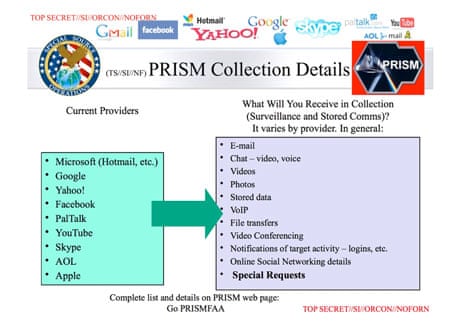 PRISM is the counterpart to the upstream collection. Instead of collecting traffic as it is routed between places, PRISM uses backdoors within different companies to collect information. Yahoo, Google, and Microsoft are all participants in the program.
Much of our communication is now encrypted, which (as far as we know) no one knows how to efficiently decrypt. BULLRUN is an example of many attempts to decrypt communications, including installing and exploiting backdoors, using mathematical techniques, and industry partnerships.
Although PRISM information can only be used and collected with a FISA court order, there is still a huge chilling effect on the First Amendment with regards to sharing opinions and thoughts. Furthermore, some argue that the government monitoring people is inherently a violation of the Fourth Amendment and a reasonable expectation of privacy.
The culmination of all of this information comes through the program XKEYSCORE. XKEYSCORE is a computer system for searching and analyzing internet traffic. The system has been compared to google.com for private internet communications. The system has also been shared internationally, especially with the Five Eyes countries.
These programs or similar ones are still going on, having been renewed in 2018 by Congress and Trump. There was little protest when the renewal occured, which signifies that Americans may have accepted the huge collection of data as inevitable or essential for the tracking of terrorists and other criminals.
Perhaps you think you’re protected by using Tor, an anonymized browser that utilizes volunteer relays to send information. However, the NSA still has been able to monitor traffic from Tor. Furthermore, using the browser would put you as a larger target within the XKEYSCORE program. Just by searching these terms, you are put under higher suspicion within the program.
Sources:

Y2K Bug

Until the 1990s, many computer programs (especially those written in the early days of computers) were designed to abbreviate four-digit years as two digits in order to save memory space. These computers could recognize “98” as “1998” but would be unable to recognize “00” as “2000,” perhaps interpreting it to mean 1900. Many feared that when the clocks struck midnight on January 1, 2000, many affected computers would be using an incorrect date and thus fail to operate properly unless the computers’ software was repaired or replaced before that date. The government, freaked out by the implications, set out to try to update all computerized systems out of the faulty software
The reason for such government urgency may not be apparent at first, but the bug had greater implications then just busting your personal computer. Banks, which calculate interest rates on a daily basis, faced real problems. Interest rates are the amount of money a lender, such as a bank, charges a customer, such as an individual or business, for a loan. Instead of the rate of interest for one day, the computer would calculate a rate of interest for minus almost 100 years! Centers of technology, such as power plants, were also threatened by the Y2K bug. Power plants depend on routine computer maintenance for safety checks, such as water pressure or radiation levels. Not having the correct date would throw off these calculations and possibly put nearby residents at risk.
In the end, there were very few problems. A nuclear energy facility in Ishikawa, Japan, had some of its radiation equipment fail, but backup facilities ensured there was no threat to the public. The U.S. detected missile launches in Russia and attributed that to the Y2K bug. But the missile launches were planned ahead of time as part of Russia's conflict in its republic of Chechnya. There was no computer malfunction. Countries such as Italy, Russia, and South Korea had done little to prepare for Y2K. They had no more technological problems than those countries, like the U.S., that spent millions of dollars to combat the problem. Due to the lack of results, many people dismissed the Y2K bug as a hoax or an end-of-the-world cult.
Sources:
https://www.nationalgeographic.org/encyclopedia/Y2K-bug/
https://www.britannica.com/technology/Y2K-bug
https://www.newscientist.com/article/2229238-a-lazy-fix-20-years-ago-means-the-y2k-bug-is-taking-down-computers-now/
Nortel Networks, A story of rags to riches... and back to rags
Now, leading up to the late 70s, Northern Electric, now known as Northern Telecom, is doing very well across the globe. This lets them spread into the data market too, providing a local area network and helping offices digitize their sales price and increasing the company’s sales and stock price. Northern Telecom then sets out to become the number 1 provider of Public and private networkers, but is outcompeted by the new and fast growing internet craze. Faced with this new problem, Northern telecoms shifts its focus from telephones to data and multimedia networking, and finally changes its name to the one its most known for, Nortel Networks.
Nortel Networks, now trying to catch up with the internet, starts buying a lot of internet startups, and with the demand for data increasing, they also start flooding the market with fiber optics. This is when the dotcom bubble starts to grow and Nortel’s stock starts to skyrocket, even though they aren't really making any money because of all the acquisitions that had already happened. Between 1998 and 2000 the company is unable to record a single annual profit, leading management to remove acquisitions off the expenses to make it look like they are making a profit when they really aren't. Investors are fooled by this new number and keep on buying stock from it, making it the 9th most valuable company in the world.
This all ends though when the dotcom bubble that I have talked about in earlier blogs finally pops. Nortel Networks was relying on the idea that fiber optics would always be in high demand, and it is soon proven that this really isn’t the case. With other tech companies dropping like flies demand dries up and the tech industry starts to slow down. Finally in 2001, with sales missing their expectations, Nortel finally admits that it won’t be making any profit, causing investors to run for their lives. Desperate for change, Nortel Management takes some of its savings and adds it to the annual earnings to make it look like they were finally earning money. However, this is soon figured out and Nortel uses the rest of its money fighting a lawsuit against fraud, causing it to eventually die out.
Sources:
https://www.youtube.com/watch?v=EKjAMxzdrHw
https://www.theglobeandmail.com/report-on-business/the-story-behind-nortels-fall/article4156221/
http://www.fundinguniverse.com/company-histories/nortel-networks-corporation-history/
The Quattrone Scandal
 Frank Quattrone was one of the biggest American Technology investment bankers after the 1990s tech boom. He was responsible for starting technology sector franchises at Morgan Stanley, Deutsche Bank, and Credit Suisse First Boston, and even helped technology companies like Netscape, Cisco, and Amazon.com go public during the tech boom. He also drove his firm, Qatalyst Partners, to one of the top M&A advisors to technology companies, advising on $33bn worth of US tech transactions in 2015, within the top 20 US M&A advisors. Though he had some roots in the tech boom, Quattrone really took off with the dotcom bubble, only to crumble, when the bubble was finally popped.
Quattrone first arrived in California in 1979 as a junior banker for Morgan Stanley. The large New York-based firms at the time considered the technology industry to be too small to devote large resources to, leaving niche West Coast firms such as Hambrecht & Quist and Robertson Stephens to service emerging companies. Finally, his long standing roots in the tech community paid off when the dotcom bubble exploded. He left Morgan Stanley and soon after, Credit Suisse First Boston hired Mr Quattrone to lead its technology practice, which he quickly made competitive against titans Morgan Stanley and Goldman Sachs. At Credit Suisse, his team of hundreds included not just bankers but research analysts and wealth managers who reported directly to him. His annual compensation was assumed to be in excess of $100m.
As the dotcom era collapsed, however, the conflicted arrangements by which bankers had control over other areas of the firm drew scrutiny. Several common practices connected with IPOs came under attack in the press leading to investigations by the U.S. Securities and Exchange Commission, the National Association of Securities Dealers, and a federal grand jury. Quattrone feared being charged in connection with such acts and therefore engaged in obstruction of justice.
It was soon released that Quattrone, among other bankers had destroyed valuable evidence for the government’s IPO probe while they were still under subpoena by the government. Destroying evidence is, as we all know, a case of obstruction of justice and Quattrone was brought in and sentenced 18 months in prison. However, through a miracle, Quattrone was able to beat back 1 count of obstruction of justice and another count of witness tampering. Basically, he argued that he was unaware of the subpoena that was put in place when he destroyed the evidence and he was adhering to company policy, which allowed him to destroy files that were old and outdated.
Sources:
https://www.ft.com/content/4d17337a-c53c-11e5-808f-8231cd71622e
http://www.nbcnews.com/id/11928477/ns/business-corporate_scandals/t/frank-quattrones-conviction-overturned/#.XpnTpDrYphE
https://en.wikipedia.org/wiki/Frank_Quattrone
https://atlassociety.org/commentary/capitalism-and-morality/capitalism-morality-blog/3647-the-case-for-frank-quattrone
Subscribe to:
Posts (Atom)