Tuesday, February 4, 2020

The History of Aunt Jemima's Pancake Mix


The History of Aunt Jemima's Pancake Mix

The history of Aunt Jemima's pancake mix dates back to 1889 when Chris Rutt and Charles Underwood bought a bankrupt flower mill and created the recipe in order to increase demand for flour. Originally, the pancake mix was named "Self Rising Pancake Flower", but after Rutt saw a minstrel show featuring Peter Baker, a black face actor who performed as Aunt Jemima, he decided to name the mix Aunt Jemima.


Later, Rutt and Underwood would sell their company to R.G. Davis who would expand Aunt Jemima nationwide. Davis would develop Aunt Jemima’s image around the country by hiring former slave, Nancy Green and advertiser, James Webb Young. Nancy Green would portray Aunt Jemima, and during an 1893 World Fair in Chicago, Green would cook pancakes and tell stories about living on old plantations in the South. By 1910, they had become pretty popular and peaked in popularity during the 1920s and 1930s. The enticing ads that Young created would “appeal to a certain type of nostalgia--maybe for a world that never existed--but for a world that is depicted as very gracious, luxurious, slow, and gentle, as a place where there were people ready to do things for you at a moment’s notice.”


Aunt Jemima pancake mix was originally targeted at white housewives as “a slave in a box” because “it drew heavily on the themes of plantation slavery and on the servant who had the time and the ability to do things you don’t feel competent to do yourself.” Eventually, African Americans started critiquing the image of Aunt Jemima, a woman who was depicted with big lips and a broad smile, during the Civil Rights movement. Their critiques were heard after Davis sold Aunt Jemima to Quaker Oats. In 1960, Quaker Oats decided to change Aunt Jemima's appearance to be slimmer and lighter skinned. Then, in 1989, Quaker Oats decided to change Aunt Jemima’s appearance again by taking off her accessories and making her look like a working grandma. This is also the appearance that is on the pancake box today.


Overall, the seemingly harmless image of Aunt Jemima has a much deeper history than many people think. The appearance of Aunt Jemima pancake mix embodies the racist stereotypes that have prevailed throughout American history.


Sources:https://en.wikipedia.org/wiki/Aunt_Jemima

https://blogs.scientificamerican.com/food-matters/not-gone-with-the-wind-the-perpetuation-of-the-mammy-stereotype/

Monday, February 3, 2020

Robert McNamara and the Flexible Response Policy

Robert Strange McNamara was an American businessman and the eighth Secretary of Defense. He worked under President John F. Kennedy and Lyndon B. Johnson between 1961 to 1968. He graduated from UC Berkeley in 1937 and later received a graduate degree from Harvard Business School. He was illegible to serve in WWII due to his vision, so he contributed by developing logistical systems for bomber raids and the monitoring of troops and supplies.

He assumed presidency of the Ford Motor Company in 1960 before resigning and becoming the secretary of defense under JFK. He redesigned the budget procedures of the Pentagon by cutting costs on what he thought were outdated weapons. He also was a major player in changing Eisenhower's increasingly unpopular policy of "massive retaliation" to a more versatile "flexible response." The basis of the strategy, rather than clapping back after an attack with greater force, called for mutual deterrence at many different levels, allowing the capability to respond to any conflict, not just that of nuclear weapons. Mutual deterrence, or mutually assured destruction (MAD), is an idea where complete use of nuclear weapons by two opponents would result in the utter destruction of both sides. The security that comes with this is known as the theory of deterrence, which states that threatening an enemy with nuclear weapons, or any powerful weapons at all, would prevent the enemy from using identical weapons in an attempt to prevent destruction. Although "flexible response" initially created during the Cold War in response to the threat of nuclear attack, it still remains a fundamental aspect of American military thinking.

Image result for robert mcnamara"In his later years, he advocated for deeper military involvement in Vietnam and was very optimistic about the outcome of the Vietnam War. Additionally, after leaving the Pentagon, he assumed the presidency of the World Bank. He fought issues of world hunger and East-West relations, along with publishing numerous policy papers and writing his own book, Blundering into Disaster: Surviving the First Century in a Nuclear Age, and a memoir, In Retrospect: The Tragedy and Lessons of Vietnam. 

McNamara died on July 6, 2009. He was 93.


Sources:
https://www.biography.com/political-figure/robert-s-mcnamara
https://www.britannica.com/biography/Robert-S-McNamara
https://www.britannica.com/topic/Flexible-Response
https://upload.wikimedia.org/wikipedia/commons/2/2b/Robert_McNamara_official_portrait.jpg

Sunday, February 2, 2020

The Butter Battle Book

As a child, you might remember reading about green eggs and ham, a dog party, the foot book, a turtle named Yertle, and a war over how to butter toast?
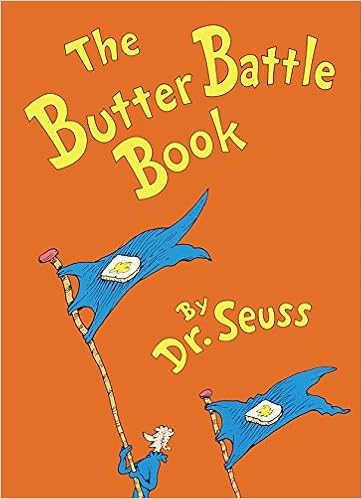
 Yes, such a book does exist! In 1984 Dr. Suess published a book aptly titled, “The Butter Battle Book”. On the surface, the book follows a disagreement between the Yooks, who have their bread butter side up, and the Zooks, who have their bread butter side down. Although taking a closer look, the book is meant to represent the arms race during the Cold War between the United States and Russia.
Image result for the butter battle book
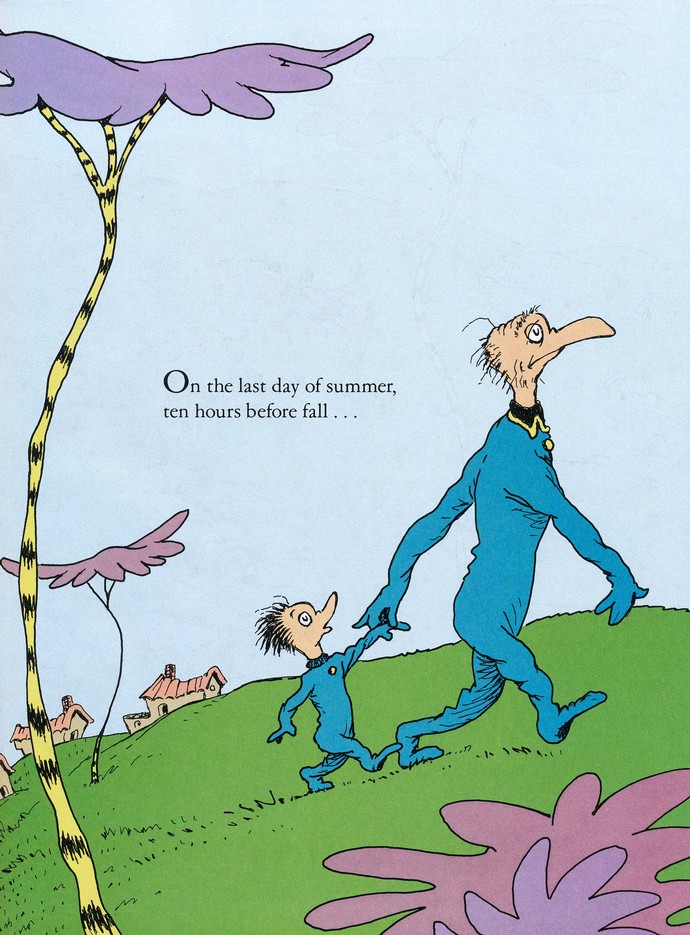
 The book begins with an old war veteran (the narrator) and his grandchild near a tall wall that stretches off the page. There the grandfather begins to tell the story of the Butter Battle between the blue colored Yooks and the orange colored Zooks. The narrator goes back in time to when he was on border patrol to keep an eye on the Zooks, back when the wall was short enough to look over.
Image result for the butter battle book
It started out with small weapons such as catapults, but as the book goes on the weapons become more and more dangerous. If one side feels threatened, they bid a hasty retreat, then quickly return with a weapon even more lethal.
Image result for the butter battle book the boys in the back
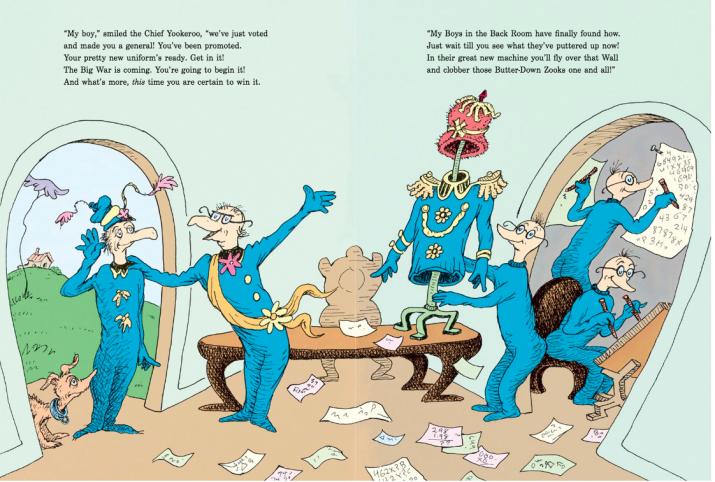
 Where do these new and improved weapons come from? From none other than “the boys in the back room” of course. Both sides refer to them as this, yet we only see the Yooks' “boys”. These people are shown off to the side whenever Chief Yookeroo is showing the narrator their latest and greatest invention. In the back room, they are depicted as furiously designing or sketching the next weapon.
 The last time the narrator is seen to visit the chief and the boys, both are hiding in the back room, the door now closed. The chief hands the narrator a small object called the “Bitsy Big Boy Boomerro”, which is a bomb to use on the Zooks. The next page shows all of the blue Yooks lining up and going single file down into a hole in the ground. This closely resembles American citizens preparing for nuclear war and going into bomb shelters.
 The reader is taken back to “present day” when the narrator is no longer the grandfather, but the grandchild. We learn that the grandfather still has possession of the bomb, and that he is preparing to drop it.
Image result for the butter battle book
He goes up onto the wall and is met with a Zook who also has a similar looking bomb. Both stare at each other, as if daring the other to drop it. The book ends with the two at a stalemate, similar to how the Cold War ended.

Sources:
https://theoutline.com/post/5601/dr-seuss-the-butter-battle-book-history?zd=1&zi=uitiljr2 https://www.shmoop.com/butter-battle-book/meaning-2.html
https://www.youtube.com/watch?v=ut1CSRmVp0I

Brown v. Board of Education

          In 1896, the court ruled that segregation was legal as long as the facilities were equal between whites and blacks - Plessy v. Ferguson. As a result, buses, schools, neighborhoods and more were protected behind the "Jim Crow laws" and remained constitutional until 1954.
          In the 1950s, Oliver Brown had challenged the Supreme Court after his daughter was denied entrance into an all-white elementary school. Brown stated that the schools were unequal which violated the equal protection clause and argued that black people were withheld equal protection of the law which violated the 14th amendment. At first, the case was undecided, but after the chief justice was replaced with Earl Warren, de-segregation had succeeded; Warren argued that segregated schools were unequal and that this deprived the laws guaranteed by the 14th amendment.
         Since the supreme court had not specified the process of desegregating schools, there were controversial arguments over the subject and some states in the south even rejected the idea altogether. For example, in Little Rock, Arkansas, Governor Orval Faubus had prevented black children from entering a white school by using the national guard. This forced President Eisenhower to get involved and resulted in the use of federal troops who assisted the "Little Rock Nine." These nine black students were then able to go to school under armed protection.
      As a result of the ruling in Brown v. Board of Education, the Civil Rights Movement was prompted across the US. A year later, Rosa Parks refused to give up her seat which led to more demonstrations and bus boycotts which ignited the creation of new laws.
      Overall, the decision in this case would help to overturn many laws re-enforcing segregation and assist with the integrating of schools. While black people continued to be unlawfully oppressed after Brown v. Board of Education, it had sparked Civil Rights Movements which would eventually be lead by Martin Luther King Jr.

Sources: https://www.history.com/topics/black-history/brown-v-board-of-education-of-topeka
                                                    Image result for brown v the board of education

Gideon v. Wainwright

Gideon v. Wainwright (1963) was a historically important case that embodied Justice Hugo Black's argument that the Bill of Rights guarantees everyone protection from the state governments. This case set the standard for constitutional law for the future, forcing states to provide the rights of legal attorneys and representation, even for the poor.

It all began when Clarence Earl Gideon was charged in the Florida state court for committing the felony of breaking and entering. He was a man who had been previously spent time in and out of prison for other nonviolent crimes. At the court, he asked for an attorney, as he could not afford one himself. However, the judge denied this request, so Gideon had to represent himself in court. He cross-examined the prosecution's witnesses, presented witnesses in his own defense, and made arguments in attempts to prove his innocence. Despite these hard-fought efforts, the jury still sentenced him to five years of imprisonment.

Gideon was determined to continue fighting, so he filed a handwritten petition in the Supreme Court, in which he asked the court to resolve the question of whether the right to counsel guaranteed under the Sixth Amendment of the Constitution applies to defendants in state court. The Supreme Court agreed to hear the case.

The Supreme Court held, through a unanimous opinion authored by Black himself, that it was consistent with the Constitution to require state courts to appoint attorneys for defendants who could not afford to retain counsel on their own. The reason for this was that the Sixth Amendment's fundamental right to counsel was required of the states by the Fourteenth Amendment. Therefore, by the Sixth Amendment, courts had to provide counsel for defendants unable to hire counsel themselves.

Sources:
https://www.oyez.org/cases/1962/155
https://www.uscourts.gov/educational-resources/educational-activities/facts-and-case-summary-gideon-v-wainwright


Saturday, February 1, 2020

Freedom Summer

In the 1960s, the Civil Rights Movement was at its peak, with African Americans across the country campaigning for equal rights and an end to segregation. There was support for the movement in liberal groups and prominent leaders, but they met fierce resistance from groups such as the Klu Klux Klan. And despite all the gains that had been made, African Americans still had not secured one of the most basic constitutional rights—the right to vote. Therefore, in 1964, a project called Freedom Summer or the Mississippi Summer Project, spearheaded by equal rights groups such as the Student Nonviolent Coordinating Committee (SNCC) and the Congress on Racial Equality (CORE), turned to the polls in an attempt to mobilize black voters. 
The need for Freedom Summer was rooted in the ways that the white south had managed to circumvent the 15th Amendment and prevent blacks from utilizing their Constitutional right. Things such as literacy tests, poll taxes, grandfather clauses, and plain violence and intimidation were used to dissuade blacks from political participation. These methods were effective; during the 1962 midterm elections, not even 7% of eligible blacks in Mississippi were registered to vote. Due to this particularly low voter turnout (even for the south), Mississippi was chosen to be the location for Freedom Summer. The plan was that the organizations would recruit volunteers, mostly white college students from the north, to work in Mississippi for the summer and register as many black voters as they could. Additionally, they set out to establish Freedom Schools, which were educational centers to teach African Americans reading, writing, math, history, and civics, as well as how to be active political participants in the government. 
Sadly, Freedom Summer was not very successful in its original goals. Out of the 17,000 blacks who tried to register to vote, only 1200 were ultimately successful. They did manage to create 40 Freedom Schools and educate around 3000 students. Volunteers and residents were met with extreme violence from white protesters and the KKK. On the very first day of the project, three volunteers, James Chaney, Mickey Schwerner, and Andrew Goodman disappeared. About a month later, their bodies were found inside a dam in Philadelphia, having been lynched by members of the KKK. While Schwerner and Goodman had been shot once in the chest, Chaney, the only African American, had been shot multiple times and savagely beaten. Many volunteers’ homes were firebombed and more were beaten by the police or white mobs. 
However, the violence and cruelty of the white resistance to Freedom Summer made national headlines, stirring up sympathy and support for the Civil Rights Movement by the public. Despite not registering a huge amount of Mississippians, national attention was brought to the issue of black disenfranchisement. This lead to the passage of the Civil Rights Act of 1964 and the crowning achievement, the Voting Rights Act of 1965. 


Sources:


The US and Cuba: A Complicated History

The U.S. and Cuba have a long, complicated history that started years before Fidel Castro came into power in 1959.  Cuba was originally a territory of Spain that was relinquished at the end of the Spanish-American War in 1898.  The U.S. gained control of Cuba (as well as Puerto Rico and Guam).  The U.S. granted Cuba with independence while keeping Puerto Rico and Guam as United States territories (which they still are).  The U.S. occupied Cuba in 1899 and prepared a constitution for the country.  The U.S. military ended up leaving Cuba in 1902 and the Cuban Republic is born. 
However, the U.S. doesn't stay out of Cuba for long.  In 1906 the American military occupies Cuba again to put down a rebellion and governs the country until 1909.  The U.S. continued to invest in the country and helped put down various rebellions in Cuba. American companies were present in Cuba and it was a vacation spot for many Americans.  This cooperation didn't last long.
Fidel Casto and his followers overthrew the Cuban government in 1959. The United States had initially supported Castro and recognized him as the leader of Cuba, and Castro even came to the U.S. and visited Nixon at the start of his rule.  Then things started to go downhill.  Under Castro's rule, in 1960 all U.S. businesses in Cuba are nationalized without compensation.  The U.S. responds with a partial trade embargo on the country, which is extended to a full embargo in 1962.   U.S. diplomatic relations are severed with the country in 1961, and to this day, the countries communicate through Switzerland.  The Cuban Missile Crisis, one of the most famous events of the Cold War, happens in October 1962.  Despite the loss of diplomatic relations and travel between the countries, the United States continues to operate Guantanamo Bay, a U.S. base that houses around 4,000 members of the U.S. military in Cuba. 
The current state of relations between the U.S. and Cuba are unsteady.  In 2016, President Obama lifted some restrictions on American travel to Cuba, which allowed U.S. citizens to travel to Cuba without permission from the U.S. government.  This new freedom only lasted a few years, with President Trump adding restrictions on travel to Cuba.  As of November 22, 2019 "Travel to Cuba for tourist activities remains prohibited, and U.S. federal regulations restrict travel to Cuba to licensed travelers engaged in certain specified activities. " (U.S. State Department)
Sources: http://content.time.com/time/nation/article/0,8599,1891359,00.html
https://www.state.gov/u-s-relations-with-cuba/
https://cri.fiu.edu/us-cuba/chronology-of-us-cuba-relations/
https://www.nytimes.com/2016/03/16/us/politics/white-house-cuba-restrictions.html